Kitap Hakkında
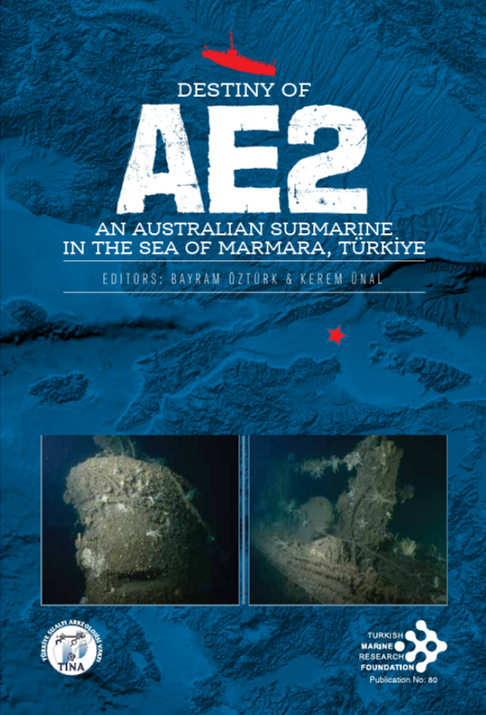
During the First World War, which took place between 1914 and 1918, Australian and New Zealand forces—known as the Anzacs—landed on the Gallipoli Peninsula as part of the Gallipoli Campaign, alongside British Commonwealth forces. Winston Churchill, the First Lord of the Admiralty at the time and one of the campaign’s political advocates, supported the decision to delay the withdrawal, despite the failures of the land forces, following the passage of the Australian submarine AE2 into the Sea of Marmara. Some historians argue that this development led to the prolongation of the campaign and resulted in heavy casualties.
The Ottoman Navy’s Sultanhisar torpedo boat detected the AE2 submarine and launched an attack, causing the submarine to sustain heavy damage. Consequently, the submarine was scuttled by its crew; however, the entire crew was taken prisoner. The confrontation between Australian forces and the Ottoman Empire on the Gallipoli Front has given this event a special place in Australian history, and the subject continues to be discussed with interest in the country to this day.
On 11 November 2000, at a reception organised by the Australian Defence Force in Sydney, Mr Selçuk Kolay, who discovered the AE2 submarine wreck following extensive research and who had served on the Board of the TINA Foundation, was in attendance as a guest. I also had the honour of attending this event alongside him. Mr Kolay, who was awarded an honorary medal for his contributions to Australian maritime history, generated great excitement in Australia and became a significant source of prestige both for himself and for Türkiye. He did not limit himself to this discovery alone, but also made important contributions to joint efforts aimed at the preservation of the submarine wreck.
The TINA Foundation has shown interest in and supported the project at every stage. It also made representations to the Ministry of Culture, and the then Minister of Culture, Mr İstemihan Talay, personally contributed by chairing the workshop organised on the AE2 submarine. Furthermore, I had the opportunity to meet Fred and Elizabeth Brenchley, the authors of “Stoker’s Submarine”, in Canberra, the capital of Australia, and secured the publishing rights for the book in Türkiye. We subsequently published it in Turkish with Mr Selçuk Kolay.
Years later, as part of another event, we at TINA The Turkish Foundation for Underwater Archaeology are delighted to have published the volume you hold in your hands, “Destiny of AE2: An Australian Submarine in the Sea of Marmara, Türkiye”, in collaboration with my dear professor Mr Bayram Öztürk and the Turkish Marine Research Foundation (TUDAV) that he represents.
Izmir, March 2026
H. Oğuz Aydemir
Chairman of the Board
TINA The Turkish Foundation for Underwater Archaeology
Studying underwater cultural heritage and the shipwrecks of the Gallipoli Campaign is an important issue for TUDAV and one of the prioritized research topics for the coming years.
More specifically, AE2, lying in the depths of the Sea of Marmara, has always been on the radar of the underwater experts of TUDAV. Constituting underwater cultural heritage of unique importance for both Türkiye and Australia, the destiny of AE2 is noteworthy. AE2, once a symbol of the war and of difficult times for the Turkish nation, became an eminent example of peace and cooperation between nations, especially in these days when nations need more than ever the spirit of peace and the conscience of humanity.
The present book sets sail with the ultimate goal of strengthening human bonds. As a cruel reality, wars are made of blood, tears, and steel. Yet it is the same interaction between humans and steel that makes peace possible. The history of humanity is full of both examples. AE2, as a wreck made of steel and more than 100 years old, is one of the few shipwrecks that have managed to preserve themselves in the depths of Karabiga in the Sea of Marmara.
When mentioning gratitude, one should never forget the hero of the Gallipoli Campaign and the founder of the modern Republic of Türkiye, Mustafa Kemal Atatürk, a master of both war and peace, who described war as a murder unless a nation’s life faces peril.
The present book on the destiny of AE2 stands as a good example of learning from the lessons of humanity. It reflects the spirit of cooperation between the Turkish and Australian nations.
This book encompasses several chapters from different disciplines. These include the discovery of the wreck, the various aspects of diving expeditions to AE2, the technical characteristics of AE2, the story of Sultanhisar and AE2, and their brave captains Ali Rıza and Henry Stoker, the oceanographic conditions of the Çanakkale Strait, the protection measures related to the AE2 wreck, and the legal status of the AE2 submarine wreck under international law. We believe that all these chapters will fill the gap in terms of better decisions for the destiny of the AE2 wreck.
As TUDAV, we would like to thank all the authors who contributed to this book by writing a chapter. We hope that this book will contribute to awareness of the AE2 wreck, an underwater cultural heritage, and to peace between nations.
I am pleased to present this publication to the scientific community and all stakeholders who are interested in the Gallipoli Campaign, the war heritage of different countries, and its preservation.
Istanbul, March 2026
Bayram Öztürk
Head of the Turkish Marine Research Foundation


Yorumlar
İlk Yorumu Ekle